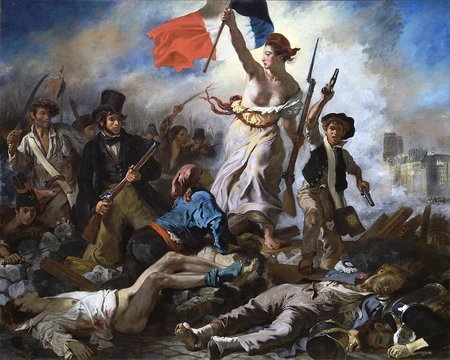
July Revolution
Three days that ended the Bourbon monarchy in France.

Salim Khandoker · CC BY-SA 4.0
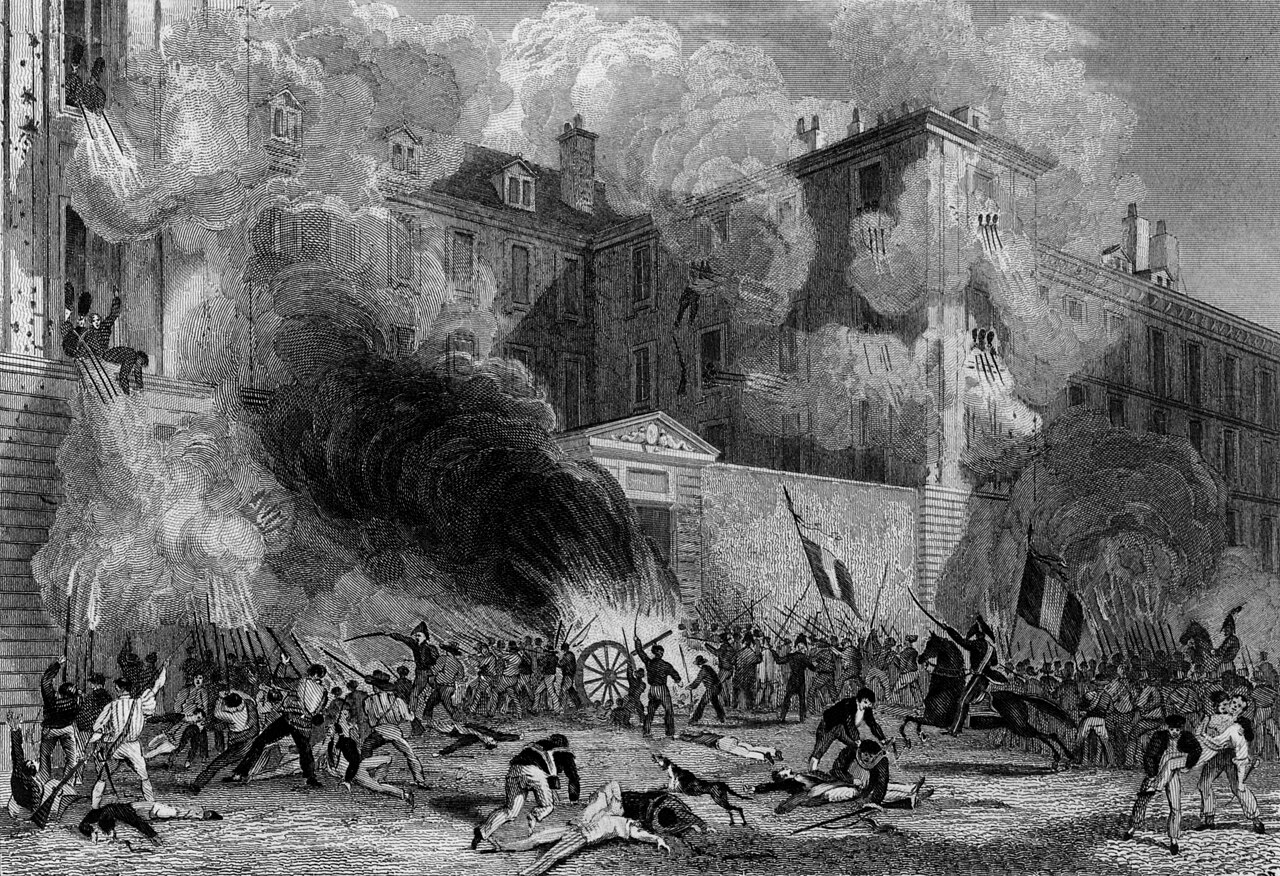
The July Revolution (French: Révolution de Juillet), also known as the French Revolution of 1830, Second French Revolution, or les Trois Glorieuses ("the Three Glorious [Days]"), was a second French Revolution after the first of 1789–99. It led to the overthrow of King Charles X, the French Bourbon monarch, and the ascent of his cousin Louis Philippe, Duke of Orléans, who governed for 18 years as the last king of France. The 1830 Revolution marked a shift from that point on as the constitutional monarchy was restored with the July Monarchy; the definite fall of the House of Bourbon in favour of its cadet branch, the House of Orléans; and the replacement of the principle of hereditary right by that of popular sovereignty.
- Date
- 27–29 July 1830
- Location
- Paris, France
- Result
- Overthrow of Charles X; ascent of Louis Philippe
- Key Figures
- Charles X, Louis Philippe, Jules de Polignac
- Also Known As
- French Revolution of 1830, Second French Revolution, les Trois Glorieuses
Verified Timeline
Lore & Background
After Napoleonic France's defeat and surrender in May 1814, the Congress of Vienna restored the House of Bourbon under Louis XVIII, who was forced to grant a constitution, the Charter of 1814. On 16 September 1824, Louis XVIII died childless, and his younger brother Charles, aged 66, inherited the throne. Charles X's coronation at Reims Cathedral on 29 May 1825 was elaborate; the comte de Chabrol declared: 'Proud to possess its new king, Paris can aspire to become the queen of cities.' But eight months later, public opinion had sharply worsened. Two main causes were the imposition of the death penalty for anyone profaning the Eucharist (the Anti-Sacrilege Act) and provisions for financial indemnities for properties confiscated by the 1789 Revolution and the First Empire. On 12 April, the Chamber of Deputies rejected the government's proposal to change inheritance laws; Le Constitutionnel called it 'a victory over the forces of counter-revolutionaries and reactionism.' On 16 April 1827, while reviewing the Royal Guard in the Champ de Mars, the king was greeted with icy silence, and many spectators refused to remove their hats. Charles X later told his cousin Orléans that 'although most people present were not too hostile, some looked at times with terrible expressions.' On 30 April, the king dissolved the National Guard of Paris. On 17 March 1830, the Chamber of Deputies passed the Address of the 221, a motion of no confidence against the king and Polignac's ministry. Charles dissolved parliament and delayed elections for two months. Legislative elections held between 5 and 19 July 1830 gave the liberal opposition a 274–143 majority. On Sunday, 25 July 1830, the king issued the July Ordinances, dissolving the Chamber of Deputies, suspending the liberty of the press, excluding the commercial middle class from future elections, and calling for new elections. On Monday 26 July, these decrees were published in Le Moniteur. On Tuesday 27 July, a revolution began—les trois journées de juillet—ultimately ending the Bourbon monarchy.
Reader's Guide
The July Revolution of 1830 was a pivotal event that definitively ended the Bourbon monarchy and established the July Monarchy under Louis Philippe, a member of the cadet House of Orléans. It replaced the principle of hereditary right with that of popular sovereignty, though the new king would be overthrown in the French Revolution of 1848. The revolution created lasting political divisions: supporters of the Bourbons were called Legitimists, supporters of Louis Philippe were known as Orléanists, and there continued to be Bonapartists supporting the return of Napoleon's heirs. The three days of fighting, known as les Trois Glorieuses, were triggered by Charles X's July Ordinances. On Monday, 26 July 1830, it was a hot, dry summer. Members of the Bourse refused to lend money, and business owners shuttered their factories; unemployment spiked. Nearly 50 journalists from a dozen city newspapers met in the offices of Le National, signed a collective protest, and vowed their newspapers would continue to run. That evening, police raided a news press and seized contraband newspapers, greeted by a sweltering, unemployed mob angrily shouting, 'À bas les Bourbons!' and 'Vive la Charte!' Armand Carrel wrote in Le National: 'France... falls back into revolution by the act of the government itself... the legal regime is now interrupted, that of force has begun... obedience has ceased to be a duty.' Despite public anger, Paris Préfet de police Jean-Henri-Claude Magin wrote that evening: 'the most perfect tranquility continues to reign in all parts of the capital.' On Tuesday, 27 July 1830, Paris grew quiet as the milling crowds grew larger. At 4:30 pm, commanders of the troops of the First Military division of Paris and the Royal Guard were ordered to concentrate their troops and guns on the Place du Carrousel facing the Tuileries.
Did You Know?
- The July Revolution is also called 'les Trois Glorieuses'—'the Three Glorious [Days]'—referring to 27–29 July 1830.
- Charles X's coronation at Reims Cathedral on 29 May 1825 included the comte de Chabrol declaring Paris could 'aspire to become the queen of cities.'
- On 16 April 1827, while reviewing the Royal Guard, Charles X was greeted with icy silence and many spectators refused to remove their hats.
- The Address of the 221 was a motion of no confidence passed by the Chamber of Deputies on 17 March 1830 against Charles X and Polignac's ministry.
- After the July Ordinances were published on 26 July 1830, nearly 50 journalists from a dozen newspapers met at Le National and signed a collective protest.
The Overthrow and the New Monarchy
The July Revolution of 1830, remembered in popular memory as "the Three Glorious Days," represented France's second great revolutionary upheaval following the original revolution of the 1790s. Its central political consequence was the removal of Charles X, the last Bourbon king to sit on the French throne, and the installation of his cousin Louis Philippe, Duke of Orléans, as the new monarch. Louis Philippe would hold the crown for eighteen years before his own overthrow in 1848. The revolution fundamentally altered the constitutional architecture of French monarchy: the House of Bourbon was permanently displaced in favor of the cadet Orléans branch, and the governing principle shifted from hereditary right to popular sovereignty. The restored constitutional monarchy that emerged became known as the July Monarchy, a regime that attempted to balance royal authority with parliamentary legitimacy. This transition also crystallized the political factions that would dominate French politics for decades—Legitimists clinging to the senior Bourbon line, Orléanists backing the new king, and Bonapartists still hoping for a return of Napoleon's dynasty.
The Post-Napoleonic Settlement and the Charter
The political landscape that made the 1830 revolution possible was shaped in the aftermath of Napoleon's final defeat in May 1814. The Congress of Vienna, where decision-making was dominated by four great powers—the Austrian Empire under Prince Metternich, Britain under Viscount Castlereagh, Russia under Alexander I, and Prussia under Frederick William III—redrew Europe's map. France's foreign minister, Charles Maurice de Talleyrand, leveraged his position at the Congress by arguing that French cooperation with Napoleon had been coerced, and he successfully lobbied for France's restoration to its pre-Napoleonic borders. The Bourbon dynasty, which the original revolution had deposed, was reinstated with Louis XVIII on the throne. However, the Congress imposed a critical condition: Louis was required to grant a constitution, the Charter of 1814, which enshrined certain civil liberties and guarantees of religious equality. This constitutional framework would become the flashpoint around which Charles X's reign—and ultimately his overthrow—would revolve.
Charles X and the Erosion of Royal Authority
Charles X ascended to the French throne in September 1824 after the death of his childless elder brother Louis XVIII. His coronation at Reims Cathedral in May 1825 was marked by elaborate ceremony and public acclaim. Yet within eight months, the capital's mood had turned sharply against him. Two legislative measures proved particularly damaging: the Anti-Sacrilege Act, which imposed the death penalty for desecrating the Eucharist and was seen as a violation of the Charter's guarantees of religious equality, and a scheme of financial indemnities for properties confiscated during the 1789 Revolution and the Napoleonic era, which critics framed as a punitive measure against those who had not emigrated. The king's authority continued to erode. In April 1827, while reviewing the Royal Guard at the Champ de Mars, he was met with icy silence and many spectators refused to remove their hats. The government's attempt to impose tighter press censorship was roundly rejected by the Chamber of Deputies, and in April the king abruptly dissolved the National Guard of Paris, a move that alienated even moderate supporters.
The Long Shadow of 1830
The political realignments set in motion by the July Revolution reverberated through the remainder of the nineteenth century. The July Monarchy that Louis Philippe established introduced a constitutional framework in which the Orléans branch held power under the principle of popular sovereignty rather than the older doctrine of hereditary right. Yet the regime's foundations remained contested. The Legitimists, loyal to the senior Bourbon line, never accepted the new order, while the Bonapartists maintained a persistent campaign for the return of Napoleon's heirs. Louis Philippe's eighteen years on the throne were marked by what contemporaries described as precarious governance, and in 1848 a new revolution swept him from power. That same year, Louis Napoleon capitalized on the Bonapartist current to restore his family's political dominance. Thus, the 1830 revolution, while decisive in ending Bourbon rule, did not produce a stable political settlement; instead, it inaugurated a period of factional competition among Legitimists, Orléanists, and Bonapartists that would define French politics for the next two decades.
Gallery
Frequently Asked Questions
What is the July Revolution?
The July Revolution, often called the Second French Revolution or les Trois Glorieuses, was the 1830 uprising in France that toppled the Bourbon dynasty. It is listed as entry 19 in the Revolutions And Conflicts 1–20 series.
Who are the key figures in the July Revolution?
The central players were King Charles X, the deposed Bourbon monarch; his cousin Louis Philippe, Duke of Orléans, who took the throne afterward; and minister Jules de Polignac, whose policies helped trigger the crisis.
How does the July Revolution's story end?
The three-day revolt concluded with Charles X's abdication and flight, after which Louis Philippe was installed as the last king of France, ushering in the 18-year July Monarchy.
Why is the July Revolution important in the canon?
It permanently ended the House of Bourbon's claim to the French crown and re-established a constitutional monarchy, making it the pivotal turning point between the post-Napoleonic era and the mid-century republics.
When and where did the July Revolution take place?
The events unfolded over just three days, from 27 to 29 July 1830, centered in Paris, France.
More in Revolutions And Conflicts 1-20
Spotted an error? Know more?
This is a living reference — every entry is fact-audited, and reader corrections feed straight into our audit queue. Suggest an edit · See this site's audit record