Hussite Wars

Benutzer:Donaulustig · Public domain
The Hussite Wars, also called the Bohemian Wars or the Hussite Revolution, were a series of civil wars fought between the Hussites and the combined Catholic forces of Holy Roman Emperor Sigismund, the Papacy, and European monarchs loyal to the Roman Catholic Church, as well as various Hussite factions.
- location
- Kingdom of Bohemia
- belligerents
- Hussites vs. Catholic forces of Emperor Sigismund, Papacy, and European monarchs
- key_commander
- Jan Žižka
- known_for
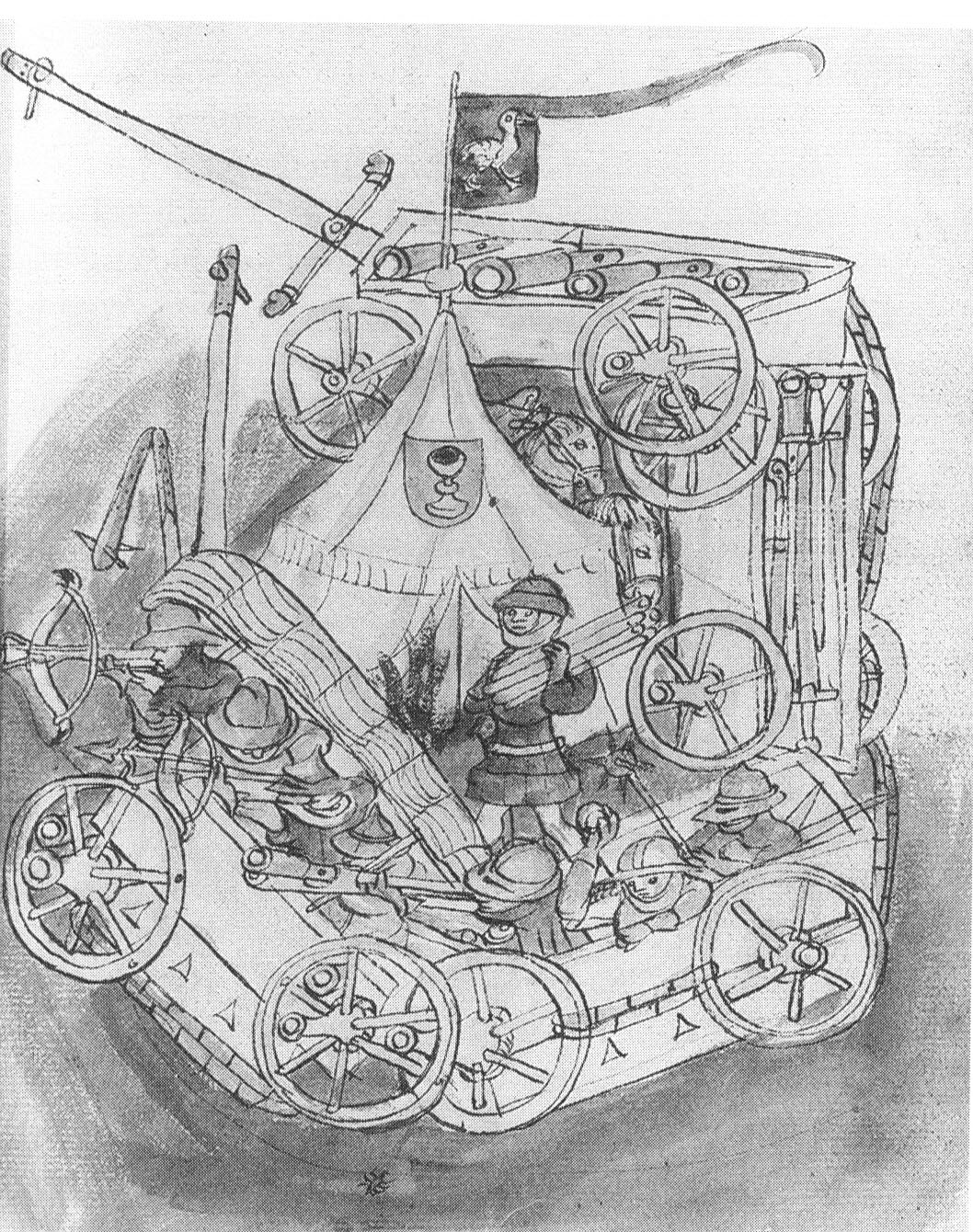
- Use of wagon forts and early handheld firearms
Lore & Background
Sigismund, who had plans to be crowned Holy Roman Emperor, suppressed the Hussite religion, yet it continued to spread. When King Wenceslaus IV of Bohemia died of natural causes a few years later, tension grew stronger. In Prague and other parts of Bohemia, Catholic Germans were forced out. Sigismund, outraged, received permission from the pope to launch a crusade against the Hussites. Large numbers of crusaders came from all over Europe, making early advances and taking Prague, but the Hussites reorganized and took back nearly all lost land, resulting in the failure of the crusade.
Reader's Guide
The Hussite Wars were significant as a major early conflict involving proto-Protestant reformist ideas and the use of innovative military tactics. The Hussite community included much of the Czech population of the Kingdom of Bohemia and formed a major spontaneous military power. The wars were notable for the extensive use of early handheld firearms such as hand cannons and of wagon forts by the Hussites. The Hussites agreed to submit to the authority of the king of Bohemia and the Roman Catholic Church and were allowed to practice their somewhat variant rite. The wars demonstrated the effectiveness of commoners using new weapons and defensive formations against traditional feudal armies, and they influenced later European warfare.
Did You Know?
- The Hussite Wars were notable for the extensive use of early handheld firearms such as hand cannons and of wagon forts by the Hussites.
- After the reins of the Hussite army were handed over to yeoman Jan Žižka, internal strife followed.
Gallery

Frequently Asked Questions
What are the Hussite Wars?
The Hussite Wars, also called the Bohemian Wars or the Hussite Revolution, were a series of civil conflicts in the Kingdom of Bohemia pitting Hussite rebels against Catholic forces backed by Holy Roman Emperor Sigismund, the Papacy, and allied European monarchs. They also involved fighting among rival Hussite factions themselves.
What military innovations made the Hussites so feared?
Hussite armies were famous for deploying wagon forts—rings of armored carts that functioned as mobile field fortifications—and for being among the first to field large numbers of handheld firearms. These combined tactics let smaller Hussite forces repeatedly rout much larger Catholic crusader armies.
Who was the standout commander on the Hussite side?
Jan Žižka, a one-eyed Bohemian general, led Hussite forces to decisive victories at Vítkov Hill and Mladá Boleslav. His skill in coordinating infantry, cavalry, and wagon-fort defenses made him one of the most effective battlefield commanders of the fifteenth century.
How does the Hussite Wars story end?
The conflict wound down through internal Hussite factional fighting and the Compacts of Jihlava and Kutná Hora in 1436, which reconciled moderate Hussites with Rome. The radical Taborite faction was ultimately defeated, and Bohemia gradually reabsorbed into the broader Catholic political order.
Why do fans rank the Hussite Wars so highly on the list?
They mark one of the earliest mass religious-and-political uprisings in Central Europe, uniting theological dissent with social demands from peasants and townspeople. Their tactical legacy—especially the wagon fort and early mass firearms use—shaped European warfare for generations.
More in Revolutions And Conflicts 1-20
Spotted an error? Know more?
This is a living reference — every entry is fact-audited, and reader corrections feed straight into our audit queue. Suggest an edit · See this site's audit record